Creating a marketing portfolio: tips and examples
Jul 05, 2024
AI Automation Engineering is becoming one of the most practical technology career paths for people who want to combine artificial intelligence, business automation, software tools, and problem-solving. Unlike traditional software development, AI automation does not always require someone to build every system from scratch. Instead, an AI Automation Engineer connects artificial intelligence models, business applications, databases, APIs, workflow automation platforms, and AI agents to create systems that can perform useful work with minimal human intervention.
For professionals, entrepreneurs, graduates, freelancers, business owners, marketers, developers, and technology enthusiasts in Nigeria, learning AI automation can provide a pathway into a rapidly developing area of technology.
In cities such as Abuja, Lagos, Port Harcourt, Ibadan, and other growing technology markets in Nigeria, businesses are increasingly looking for ways to automate repetitive processes, improve customer service, manage leads, process information, generate reports, and integrate their existing software.
This has created an opportunity for people who can understand both business problems and technology solutions.
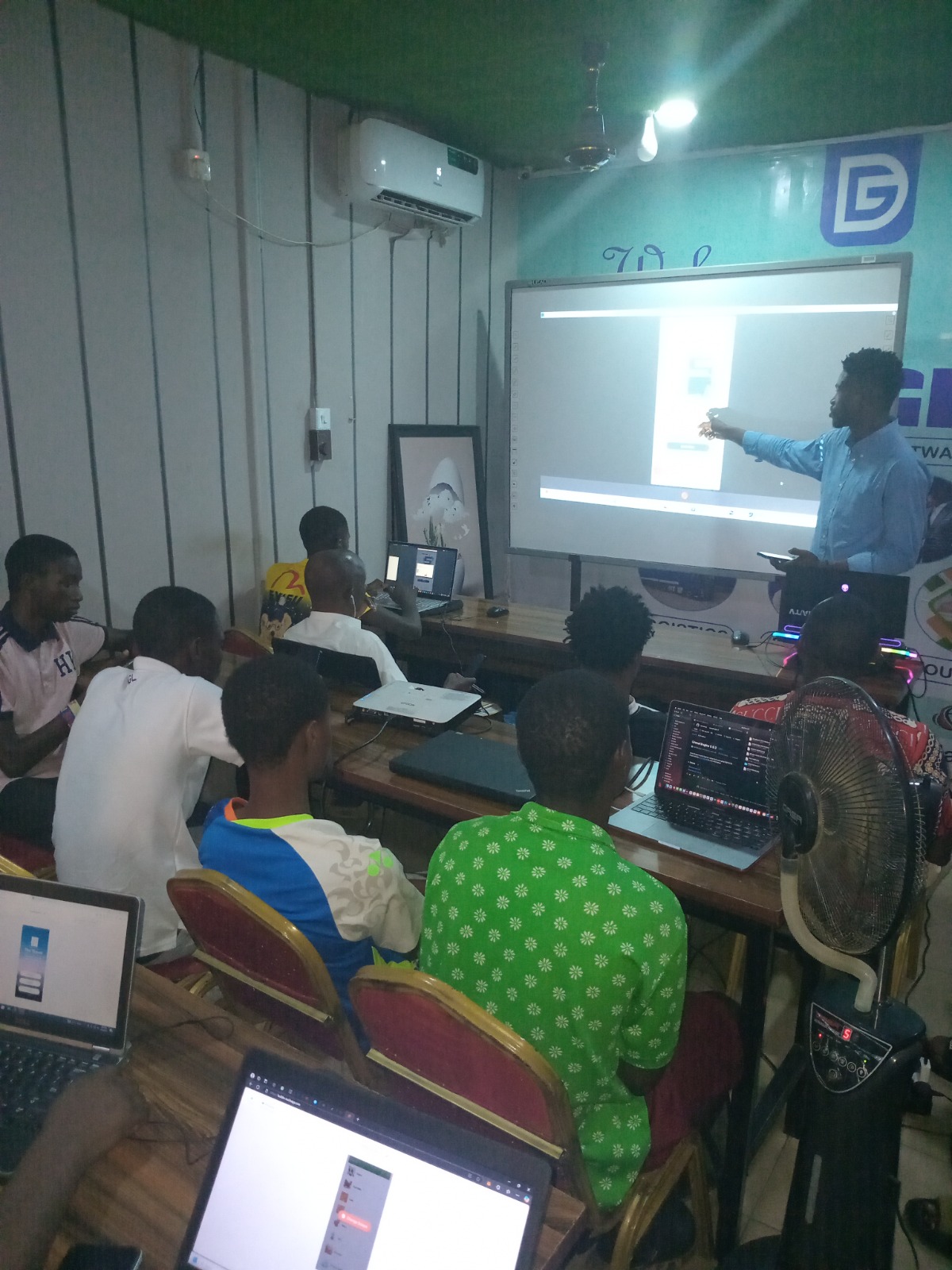
One practical place to begin this journey in Abuja is DCH Tech Academy (Darl Creative Hub Academy), which offers AI Automation Engineering training alongside other technology and digital-skills programs. Its current course catalogue lists an AI Automation Engineering training program at ₦200,000, while the academy operates physical training locations in Karu and Bwari, Abuja.
---
AI automation is the combination of artificial intelligence and workflow automation to enable systems to perform tasks that previously required people to do manually.
Traditional automation usually follows predetermined instructions:
If X happens, do Y.
AI-powered automation can go further:
Receive information, understand it, make a decision based on defined instructions, use connected tools, and perform the appropriate action.
For example, imagine a company receives hundreds of customer enquiries every week.
A traditional process might look like:
An AI-powered automated system could look like:
The objective is not simply to "use AI."
The objective is to build a system that uses AI to solve a real operational problem.
That distinction is extremely important for anyone considering AI automation as a career.
---
An AI Automation Engineer designs, builds, tests, deploys, and maintains automated systems.
Their work can involve:
Modern AI automation is therefore broader than simply learning a single platform.
An effective AI Automation Engineer learns how to connect systems together to produce measurable business outcomes.
---
Traditional automation is highly useful when the process is predictable.
For example:
There is little ambiguity.
AI automation becomes useful when the system has to deal with information that is less structured.
For example:
This is where artificial intelligence becomes valuable.
Modern workflow platforms such as n8n can combine traditional workflow logic with AI models, external applications, APIs, and AI agents. n8n's own documentation describes agentic workflows as systems where AI can reason, adapt, and interact with tools rather than merely following a fixed sequence.
---
An AI agent is an AI-powered system capable of performing tasks using a combination of:
A simple chatbot might answer:
"What are your opening hours?"
An AI agent could potentially:
The important difference is action.
AI automation therefore increasingly involves systems that don't simply generate information but use information to perform tasks.
---
Businesses have always tried to reduce unnecessary manual work.
The difference today is that artificial intelligence makes it possible to automate processes involving language, documents, classification, reasoning, summarization, research, customer communication, and other tasks that were historically difficult to automate.
Research examining thousands of publicly available n8n workflows found that practical LLM-based workflows commonly combine AI models with control logic, external tools, communication services, storage systems, and human-review points. This reinforces an important lesson: professional AI automation is much more than connecting a chatbot to an application.
Businesses can use AI automation for:
These examples demonstrate why AI automation can be applied across almost every industry.
---
It can be—but it should not be approached as a shortcut to instant money.
The strongest opportunity is not simply:
"I know n8n."
The stronger professional positioning is:
"I can identify a business problem and build an automated system that solves it."
This distinction can significantly affect your career.
A business does not necessarily care whether you used n8n, Make, Zapier, Python, an API, an AI model, or another technology.
The business cares about outcomes.
For example:
A company spends several hours every day manually transferring leads from forms into a CRM.
New leads are automatically captured, categorized, entered into the CRM, assigned to sales representatives, and followed up.
That is a business solution.
---
You do not need to master everything on day one.
A good learning path can be divided into several levels.
This is one of the most underrated skills in AI automation.
Before automating something, you need to understand how the process currently works.
Ask:
An automation engineer who understands business processes can often provide more value than someone who knows dozens of technical tools but does not understand the business.
---
Your next step is learning how workflows work.
A workflow typically contains:
For example:
This is the foundation of automation engineering.
---
n8n is one of the important tools worth learning if you want to work in AI workflow automation.
It allows users to visually construct workflows and connect applications, APIs, databases, AI models, and other services.
It can also be used for AI-agent workflows.
n8n's official educational material demonstrates how agents can use tools, retain context, interact with external systems, and perform more complex tasks.
However, don't make the mistake of thinking:
"My career is n8n."
Your career is automation engineering.
n8n is one of the tools in your toolbox.
Tools will change.
The underlying principles of automation, APIs, systems thinking, data handling, logic, debugging, and problem-solving will remain valuable.
---
APIs are extremely important.
An API allows different software systems to communicate.
For example:
or:
or:
Once you understand APIs, you become capable of connecting systems that were never designed to work together manually.
You should understand concepts such as:
You don't have to become a senior backend developer before beginning.
But you should become comfortable communicating with APIs.
---
A webhook allows one system to notify another system when an event occurs.
For example:
Webhooks are extremely important in real-world automation because they allow systems to react to events.
---
AI automation engineers should understand how large language models work at a practical level.
You should become familiar with models and platforms such as:
You should understand:
You don't necessarily need to train an LLM from scratch.
The valuable skill is knowing how to use existing models effectively inside business systems.
---
After understanding basic workflows, you can move into AI agents.
An agent might be given:
and then be allowed to determine how to accomplish the task.
For example, a sales research agent could:
That is significantly more advanced than a simple chatbot.
---
Automation systems generate and consume data.
You should therefore understand databases.
Start with:
You should understand concepts such as:
Eventually, SQL becomes highly useful.
---
You do not necessarily need to become a professional software engineer before entering AI automation.
However, programming knowledge can significantly increase your capabilities.
Start with:
Useful for:
Useful for:
A beginner can start with no-code or low-code automation and gradually introduce programming as projects become more complex.
---
JSON appears everywhere in automation.
When one application sends information to another application, the data is often structured as JSON.
For example:
{
  "name": "John",
  "email": "john@example.com",
  "interest": "AI Automation"
}
Understanding how to read, modify, transform, and validate JSON will make automation much easier.
---
This separates beginners from professionals.
A beginner asks:
"Can I make the workflow work?"
A professional asks:
"What happens when the workflow fails?"
Imagine an automation that processes 10,000 leads.
What happens if:
Professional automation must account for failure.
You should learn:
Research into real-world AI agent workflows has highlighted the importance of reliability mechanisms such as fallbacks, repair loops, alerts, and human approval gates.
---
If you are starting from zero, don't attempt to learn everything simultaneously.
Use a progressive roadmap.
Learn:
Understand what AI can and cannot do.
---
Learn:
Build simple automated workflows.
---
Learn:
Connect different applications.
---
Learn:
Put AI inside workflows.
---
Learn:
Build AI systems capable of performing multi-step tasks.
---
Learn:
Build automation systems that can store and retrieve information reliably.
---
Learn:
Go beyond the limitations of no-code automation.
---
Learn:
Deploy real systems for real users.
---
Do not spend six months watching tutorials without building anything.
Build projects.
Here are practical projects you can create.
Build:
The AI could classify leads as:
This demonstrates:
---
Build an assistant capable of:
This demonstrates AI-agent concepts.
---
Create a workflow that:
This type of workflow can have applications in legal, finance, logistics, education, real estate, and administration.
---
Build:
This is particularly useful for someone interested in sales and marketing automation.
---
Build an agent that can:
This demonstrates how AI agents can move beyond simple question-answering.
---
This is where geographical specialization becomes valuable.
Instead of building another generic AI chatbot, build something that solves a Nigerian business problem.
For example:
Building systems around local business problems can help you develop a stronger portfolio.
---
There are several career paths.
You can offer automation services to:
Services can include:
---
You can build an agency around automation.
Instead of selling yourself as:
"I build n8n workflows."
Position your agency around outcomes:
"We help businesses reduce repetitive work using AI-powered automation."
This allows you to sell solutions rather than software tutorials.
---
Organizations can hire automation professionals for:
The exact job title may vary.
Therefore, search beyond the phrase "AI Automation Engineer."
Look for related positions such as:
---
Experienced automation professionals can advise organizations on:
Consulting can eventually become more valuable than simply building individual workflows.
---
Once you understand automation deeply, you can build:
This is where automation knowledge can become entrepreneurship.
---
There is no reliable universal salary figure because income depends heavily on:
A beginner should therefore be careful with online claims promising guaranteed monthly income.
A better objective is:
The ability to generate income comes from the value of the problem you solve—not simply from possessing a certificate.
---
This is where many beginners fail.
They spend months learning tools but never learn how to sell.
Start with businesses around you.
For example, approach:
Ask:
"What repetitive process consumes the most time in your business?"
Then investigate.
Maybe the company manually:
That is an opportunity.
---
This is one of the most important lessons for an aspiring automation professional.
Don't say:
"I can build you an AI agent."
Instead say:
"I can automate your lead qualification process so new enquiries are automatically classified, recorded, followed up, and sent to your sales team."
The second statement is easier for a business owner to understand.
---
You don't need 50 projects.
Start with five excellent projects.
Your portfolio could contain:
For each project, document:
This makes your portfolio much more convincing.
---
Technology changes extremely quickly.
A person who learns only one platform may struggle when the platform changes.
A stronger AI Automation Engineer understands:
That combination is much harder to replace.
The future of AI automation is likely to involve hybrid systems where deterministic workflows handle predictable tasks while AI agents handle more ambiguous tasks. The important professional skill is knowing which type of system should handle which problem.
---
AI automation is not simply about replacing workers.
In many businesses, automation changes what workers spend their time doing.
Instead of an employee spending four hours:
automation can handle much of the repetitive work while the employee focuses on:
The person who understands how to design this collaboration between humans and AI can become extremely valuable.
---
AI automation is suitable for people from different backgrounds.
Students can begin building technical skills before entering the workforce.
Graduates can use automation as an additional career specialization.
Developers can combine software engineering with AI agents and workflow automation.
Marketers can automate:
Salespeople can automate:
Business owners can use AI automation to reduce operational overhead.
Freelancers can sell automation services locally and internationally.
Business analysts can specialize in identifying processes that are suitable for automation.
---
Not necessarily.
A computer science degree can provide valuable foundations, particularly for advanced software engineering and AI development.
However, AI automation is accessible through practical, project-based learning.
A beginner can start with:
The important thing is not to remain at the beginner level.
If you start with visual automation platforms, eventually learn the technical concepts underneath them.
That is how you move from simply being a tool user to becoming an engineer.
---
If you are looking for practical AI automation training in Abuja, one option worth considering is DCH Tech Academy (Darl Creative Hub Academy).
DCH Tech Academy is a technology and digital-skills training institution with physical locations in Karu and Bwari, Abuja, and offers programs across artificial intelligence, software development, cybersecurity, marketing, cloud computing, data analysis, and other technology areas. Its current course catalogue specifically lists AI Automation Engineering training.
DCH Tech Academy – Official Website
The academy's current website lists its AI Automation Engineering training at ₦200,000. Prospective students should confirm the latest fee, schedule, curriculum, delivery format, and available cohorts directly with the academy because training details can change.
For someone based in Abuja, FCT, particularly around Karu, Jikwoyi, Nyanya, Mararaba, Bwari, Kubwa and surrounding areas, a physical training centre can provide an alternative to trying to learn everything alone from scattered online tutorials.
DCH Tech Academy's listed physical locations are:
No. 1, Carpenter Plaza, Court Road, Karu, Ado, Abuja.
53 Law School Road, Bwari, Abuja.
---
Before paying for any AI automation course, don't simply ask:
"Do you teach AI?"
Ask more specific questions.
You should build systems, not merely watch presentations.
This should be fundamental.
These are important for connecting systems.
Modern AI automation increasingly involves agentic systems.
Real systems need data storage.
Broken workflows are part of real engineering.
A workflow that only works on a trainer's laptop is not a production system.
You need to understand why the automation exists.
Your portfolio can be more useful to a potential client than a certificate alone.
---
If you are serious about entering the industry, consider a progression like this.
Learn:
Build:
---
Learn:
Build:
---
Learn:
Build:
---
Learn:
Build:
---
Learn:
Build:
---
Create:
Then begin:
Your objective should be to obtain your first real-world automation project.
---
You can learn every AI tool available and still fail as an automation engineer.
Why?
Because automation is fundamentally about problem-solving.
A good automation engineer sees:
"This company spends five hours every day doing this manually."
and thinks:
"Why does this require five hours of human work?"
Then they investigate the process and determine:
That is engineering thinking.
---
This is another important distinction.
Prompt engineering is useful.
But professional AI automation involves much more:
If your only skill is writing prompts, you are operating at one layer of the technology.
If you can build an entire system around AI, your capabilities become much broader.
---
The most successful people will likely combine several capabilities.
You can actually build systems.
You understand what businesses need.
You can explain technical solutions to non-technical people.
You can find and convert clients.
You can identify new ways to use AI.
You can determine when AI should—and should not—be used.
You build systems that continue working after deployment.
You keep up with rapidly changing AI technology.
---
That goal is too broad.
Instead:
Build one working automation.
Build five.
Solve a real business problem.
Get your first client.
Build a repeatable service.
Specialize.
Build more advanced AI systems.
That is a much more practical career path.
---
Eventually, you can specialize.
Helping companies automate lead generation and sales processes.
Building AI-powered marketing workflows.
Building intelligent customer-support systems.
Automating internal business processes.
Building autonomous or semi-autonomous AI agents.
Automating collection, transformation, analysis, and reporting.
Automating extraction and processing of documents.
Connecting AI to customer relationship management systems.
Helping organizations redesign and automate repetitive processes.
Specialization can make your services easier to sell.
---
A practical beginner might eventually become comfortable with:
You do not need to master every tool.
Learn the concepts first.
Then learn the tool required by the project.
---
Nigeria has a particularly interesting environment for automation because many businesses still rely heavily on manual processes.
Businesses across Abuja and other Nigerian cities frequently operate through combinations of:
This creates opportunities to connect systems that previously operated separately.
For example:
That entire pipeline can potentially be designed as an automated business system.
This is one reason AI automation is particularly interesting for Nigerian entrepreneurs, agencies, SMEs, and technology professionals.
---
There is an enormous amount of AI automation information available online.
The problem is not lack of information.
The problem is knowing what to learn, in what order, and how to turn knowledge into working systems.
A structured practical environment can help a beginner move from:
to:
and eventually:
For learners in Abuja who prefer structured practical training, DCH Tech Academy is one local option to investigate. The academy currently lists AI Automation Engineering among its AI courses and maintains physical training locations in Karu and Bwari.
Explore DCH Tech Academy's courses
---
AI automation is the use of artificial intelligence, workflow automation, APIs, software integrations, and data systems to automate tasks and business processes that traditionally require manual work.
An AI Automation Engineer designs and implements systems that combine AI models with workflows, APIs, databases, applications, and business logic to automate real-world processes.
Yes. You can begin with low-code and no-code platforms such as n8n. However, learning APIs, JavaScript, Python, databases, and other technical concepts will make you considerably more capable as you progress.
Not necessarily. Practical skills, projects, technical understanding, problem-solving ability, and a strong portfolio can be valuable pathways into the field.
n8n is an important tool, but it should not be your entire skill set. Learn automation principles, APIs, AI, databases, programming, deployment, security, and business-process design as well.
Yes. AI automation can be offered as freelance implementation, consulting, workflow development, AI-agent development, CRM automation, business-process automation, and related services.
Yes. Nigerian businesses can apply AI automation to sales, marketing, customer service, logistics, real estate, education, finance, administration, recruitment, and many other processes.
DCH Tech Academy (Darl Creative Hub Academy) is one training option in Abuja. Its current course catalogue lists AI Automation Engineering training, and the academy has physical locations in Karu and Bwari.
The answer depends on your background, study time, and desired level. A beginner can start building simple workflows relatively quickly, while becoming capable of designing reliable production systems requires significantly more practice.
Start with simple projects such as lead capture automation, email automation, CRM workflows, AI classification, document processing, and customer-support systems.
---
AI automation is moving from an experimental technology into a practical business capability.
But learning about AI is not the same as learning to engineer AI-powered systems.
If you want to build a career in this field, follow a practical sequence:
And keep learning.
For people in Abuja, Nigeria who want structured, practical training, DCH Tech Academy (Darl Creative Hub Academy) is a local training option worth exploring. The academy currently offers AI Automation Engineering training and has physical training centres in Karu and Bwari, Abuja.
Learn more about AI Automation Engineering at DCH Tech Academy
If you are starting today, don't wait until you know everything.

Jul 05, 2024

Jul 10, 2024
Jul 10, 2024
Jun 06, 2024
Oct 03, 2024

Jun 12, 2024
Jul 25, 2024


Jul 03, 2025

Karu Abuja: No 1, Carpenter Plaza, Court road, Karu, Ado 900110, Federal Capital Territory.
And Bwari Abuja: 53 Law School Road Bwari
© 2025 Darl Creative Hub Academy
Ask me anything about our courses